
Biostimulants are no longer evaluated solely by their effect on vegetative development. Today, the true indicator of their efficacy lies in the final crop yield and the commercial value of the harvest. In this context, the results obtained with the application of SPIRUNOL during the 2024 season show that an improvement in plant physiology can translate into significant production increases under real growing conditions.
Eight independent trials conducted under GEP (Good Experimental Practices) standards analyzed the performance of Spirunol, a biostimulant formulated with 9% free amino acids, across different agricultural species. In all cases, the treated crops outperformed the untreated control in both yield and various quality parameters.
The highest yield increases were recorded in strawberries, where production increased by up to 76%. Significant improvements were also noted in melon (+57%), pear (+45%), lettuce (+40%), citrus (+15%), apricot (+13%), wheat (+13%), and maize (+9%).
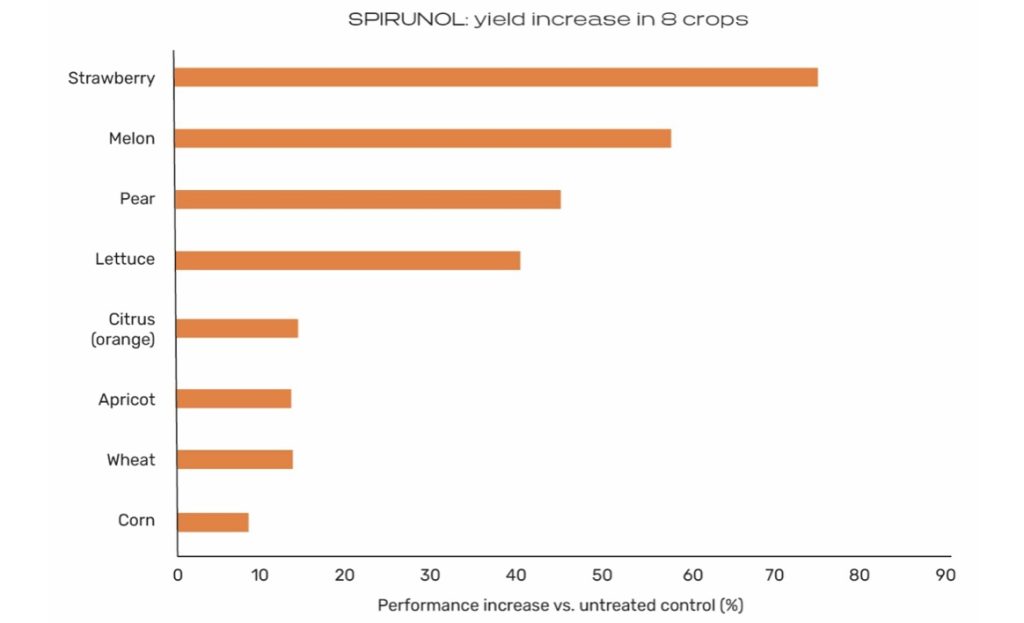
However, the increase in harvest was not the only observed effect. The trials also reflected improvements in characteristics directly related to product commercialization, such as soluble solids content (°Brix), fruit size, thousand-grain weight, and a reduction in melon cracking. These parameters reinforce the idea that greater physiological efficiency not only increases the quantity produced but also its quality.
Fruit trees show a particularly outstanding response
Among all the crops evaluated, fruit trees provided some of the most representative results of SPIRUNOL’s effect on productive potential.
In pears, the treatment increased production by up to 45%, accompanied by 39% more fruits per branch. Additionally, the fruits showed 10% to 13% improvements in soluble solids content and increases of 7% to 9% in size and height.
In citrus, the response began even before fruit formation. Fruit set increased by up to 74%, which subsequently translated into 18% more harvested fruits and a 15% increase in production compared to the control.
Apricots also recorded the highest yield in the trial, with a 13% improvement, as well as increased flowering and a 5% to 6% increase in sugar content.
Physiology as the starting point for profitability
Behind these increases lies the plant’s ability to maintain efficient physiological functioning during phases of high metabolic demand. In many crops, summer coincides with a period in which they must simultaneously sustain vegetative growth, root system development, and fruit filling or sizing, while enduring high temperatures and, frequently, water stress situations.
SPIRUNOL is formulated with 9% free amino acids that promote metabolic activity and root development, helping the plant manage its resources more efficiently during these critical moments. Added to this is the possibility of applying it both foliar and through fertigation, a dual modality that makes it easier to adapt the usage strategy to the needs of each crop and its phenological stage.
The results of the 2024 season demonstrate that productivity does not depend solely on the conditions existing at the time of harvest. A large part of the yield is built during the previous phases of the crop cycle, when the plant must respond to high energy demand without compromising its physiological balance.
The GEP trials conducted with SPIRUNOL show that optimizing these processes allows this physiological improvement to be transferred to parameters that the farmer perceives directly: more production, higher quality fruits, and a harvest with greater commercial value.