
Agronova Biotech demonstrates with Bulhnova in pistachio the viability of reducing mineral fertilization by 50% without loss of yield or soil deterioration
A multi-year study (2022–2025) under commercial conditions confirms the role of Bulhnova in nutritional efficiency and microbiome functionality in Mediterranean systems.
Agronova Biotech presented at the Almond & Pistachio Conference 2026 the results of a long-term study carried out on a commercial pistachio farm in Andalusia, which demonstrates that it is possible to reduce mineral fertilization by up to 50% while maintaining productivity, the nutritional quality of the crop and improving soil health.
The work, developed between 2022 and 2025 in Pistacia vera L. cv. Kerman, evaluated a biofertilization strategy based on PGPR microorganisms (Azospirillum brasilense M3 and Pantoea dispersa C3) under real production conditions.
Agronomic results: stable productivity with fewer inputs
The results obtained show that the 50% reduction in mineral fertilization did not compromise crop yield in any of the campaigns evaluated.
During the 2024 campaign, a high production year within the pistachio’s alternate cycle, the biofertilized plots reached production levels equivalent to conventional management (~3,200 kg/ha), also maintaining better indicators of vigor and general condition of the crop.
Visual results of the study (Figures included)
The work is accompanied by a set of agronomic, nutritional and microbiological monitoring charts, which allow visualization of the system’s evolution during the three seasons:
| Date of assessment | 23/06/2023 | 20/09/2023 | 19/06/2024 | 25/09/2025 | ||||
| Reference Jun-23 | Bulhnova Jun-23 | Reference Sep-23 | Bulhnova Sep-23 | Reference Jun-25 | Bulhnova Jun-25 | Bulhnova 2 years Sep-25 | Bulhnova 3 years Sep-25 | |
| Nitrogen (N %) | 2.05 | 2.01 | 2.04 | 2.3 | 2.5 | 2.39 | 1.92 | 1.71 |
| Phosphorus (P %) | 0.19 | 0.2 | 0.099 | 0.12 | 0.18 | 0.16 | 0.07 | 0.05 |
| Potassium (K %) | 1.47 | 1.26 | 1.93 | 1.9 | 0.75 | 0.6 | 1.66 | 1.38 |
| Calcium (Ca %) | 1.91 | 2.08 | 3.83 | 3.56 | 2 | 2 | 4.58 | 3.51 |
| Magnesium (Mg %) | 0.32 | 0.41 | 0.63 | 0.43 | 0.41 | 0.345 | 0.8 | 0.67 |
| Sulfur (S %) | 0.2 | 0.18 | 0.14 | 0.15 | 0.19 | 0.22 | 0.1 | 0.1 |
| Boron (B ppm) | 112 | 107 | 272 | 210 | 77 | 78 | 203 | 182 |
| Copper (Cu ppm) | 9.76 | 8.29 | 22.8 | 8.71 | 11.1 | 10.2 | 3.71 | 4.2 |
| Iron (Fe ppm) | 45.5 | 46.3 | 66.5 | 48.7 | 41 | 40 | 40 | 40 |
| Manganese (Mn ppm) | 27 | 29.7 | 48.3 | 32.4 | 29.2 | 73 | 38.9 | 100 |
| Molybdenum (Mo ppm) | 0.2 | 0.2 | 0.38 | 0.2 | 0.56 | 1.42 | 0.62 | 0.61 |
| Zinc (Zn ppm) | 9.32 | 9.38 | 13.5 | 7.88 | 17.8 | 22.2 | 11 | 15.6 |
- Figure 1. Evolution of foliar nutritional status (2023–2025)
It shows the stability of macronutrients (N, P, K, Ca, Mg) even under reduced mineral fertilization.
| Texture | Physicochemical properties | Macronutrients | Micronutrients | |||||||||
| Sand | 24 | % | pH | 8.37 | – | Total nitrogen | 1833 | mg kg⁻¹ | Boron | 2.87 | mg kg⁻¹ | |
| Silt | 29 | % | Electrical conductivity | 0.30 | mS cm⁻¹ | Nitrate | 168.4 | mg kg⁻¹ | Copper | 2.38 | mg kg⁻¹ | |
| Clay | 47 | % | Organic matter | 2.43 | % | Available phosphorus (Olsen) | 68.05 | mg kg⁻¹ | Iron | 4.08 | mg kg⁻¹ | |
| Oxidizable organic matter | 2.43 | % | Exchangeable potassium | 2.91 | meq 100 g⁻¹ | Manganese | 6.55 | mg kg⁻¹ | ||||
| Total carbon | 1.41 | % | Exchangeable calcium | 25.85 | meq 100 g⁻¹ | Zinc | 1.44 | mg kg⁻¹ | ||||
| C/N ratio | 7.69 | – | Exchangeable magnesium | 5.04 | meq 100 g⁻¹ | |||||||
| Exchangeable sodium | 1.37 | meq 100 g⁻¹ | ||||||||||
- Figure 2. Soil characterization under final test conditions
It reflects the high nutrient retention capacity in calcareous soils and the main limitation associated with availability rather than total content.
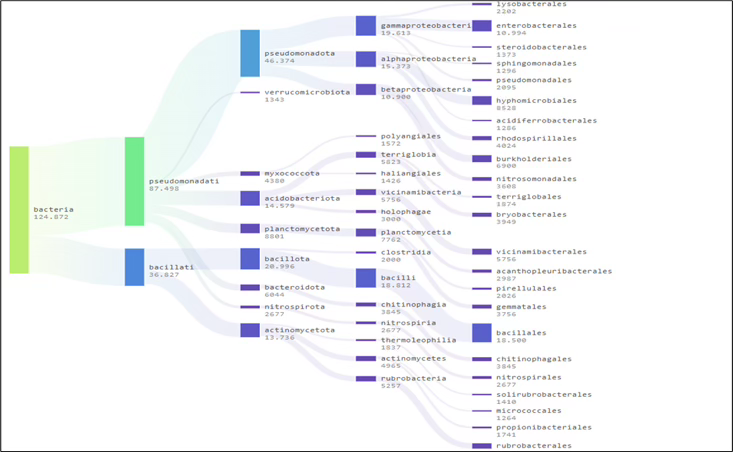
- Figure 3. Evolution of the soil microbial community (metagenomics)
It shows evidence of increased diversity and functional stability, with a dominance of groups associated with nutrient cycles and soil health.
These visual representations reinforce the consistency of the data obtained throughout the study and allow for an integrated observation of the evolution of the soil-plant-microbiome system.
A more diverse, stable, and functional microbiome
The metagenomic analysis showed a structured and functionally active microbial community, dominated by bacterial groups involved in:
- Nitrogen cycle
- Phosphorus solubilization
- Transformation of organic matter
- Ecological stability of the soil
Diversity indices confirmed a more balanced and resilient system after three years of biofertilization, with greater functional redundancy and less species dominance.
From chemical imbalance to biological equilibrium
One of the most relevant findings of the study is the disconnect between the high total nutrient content of the soil and its low actual availability to the plant, a typical characteristic of calcareous Mediterranean soils.
Activating the microbiome through biofertilization improved nutrient mobilization and optimized their use by the crop, reducing dependence on external mineral inputs.
Validation under real commercial conditions
The study began on an initial experimental block of 100 trees and, after the first results, was progressively expanded to cover the entire farm (more than 120 ha), becoming integrated into a real production management.
This progressive scaling provides a key differentiating value: the validation of the system under real commercial conditions, beyond the experimental environment.
Conclusion: Nutritional efficiency based on soil biology
The results confirm that the integration of PGPR microorganisms into biofertilization strategies allows:
- Significantly reduce the use of mineral fertilizers
- Maintaining crop productivity
- Improve soil functionality
- Increase microbial diversity
- Moving towards more sustainable agricultural systems
This study positions biofertilization as a key tool in the transition towards regenerative agriculture models based on science, applied microbiology and resource efficiency.